Lady in Paris Illustrations 1–17 JPEG: A Practical Guide for Designers and Makers
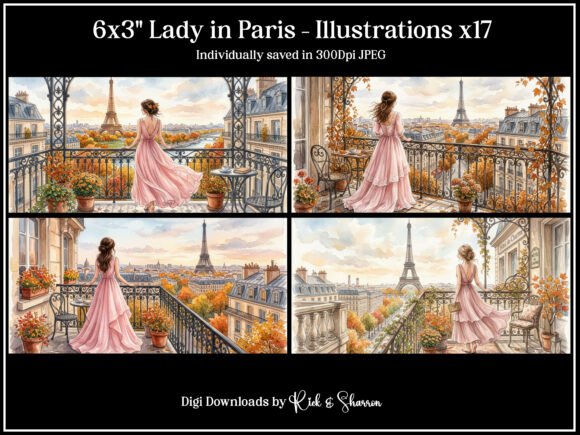
“Lady in Paris Illustrations 1–17 JPEG” refers to a curated set of seventeen original digital illustrations—each featuring elegant, stylized depictions of women immersed in Parisian settings: café terraces, Seine-side walks, book-lined bistros, flower markets, and quiet cobblestone alleys. These are not stock photos or AI-generated outputs; they’re hand-crafted vector-informed raster illustrations rendered as high-resolution JPEG files. Measuring approximately 6×3 inches at 300 DPI, they’re optimized for both print and digital integration without pixelation or scaling loss.
What Makes This Set Distinctive?
Unlike generic clipart collections or mass-produced illustration bundles, Lady in Paris Illustrations 1–17 JPEG offers stylistic cohesion without repetition. Each image maintains consistent line weight, muted yet sophisticated color palettes (think dusty rose, slate blue, warm taupe), and deliberate negative space—making them adaptable across layouts. The figures are expressive but not overly detailed, allowing room for viewer interpretation while retaining recognizability as “Parisian” in mood rather than cliché.
The commercial license is another key differentiator. You’re permitted to use these illustrations in finished products you sell—including greeting cards, digital planners, scrapbook kits, printable wall art, fabric patterns, or even small-batch stationery lines. That flexibility matters when evaluating whether a design asset fits your workflow, especially if you’re balancing time, budget, and scalability.
How It Compares With Other Illustration Options
Many designers consider three broad categories when sourcing illustrations: royalty-free stock libraries (e.g., Shutterstock, Adobe Stock), subscription-based design platforms (e.g., Creative Market bundles, The Hungry JPEG), and custom commissions. Lady in Paris Illustrations 1–17 JPEG sits between the second and third—offering bespoke aesthetic consistency like a commissioned set, but with the immediacy and affordability of a digital download.
Compared to stock libraries, this set avoids the “search fatigue” of sifting through thousands of results only to find inconsistent styles or overused motifs. You won’t need to spend hours editing mismatched colors or adjusting proportions to unify a collection—these 17 images were created as a group, with shared visual grammar.
Compared to custom illustration work, it lacks personalization—but also avoids lead times, revisions, and higher costs. If your project needs “a Parisian woman holding a croissant near a wrought-iron balcony” *by next Tuesday*, this set delivers that motif instantly, reliably, and affordably.
Practical Use Cases—and Where It Fits Best
This collection shines in contexts where tone, atmosphere, and subtle storytelling matter more than literal realism. For example:
- Greeting card designers appreciate how each illustration functions as a self-contained focal point—no cropping or masking needed for standard 5×7 or A6 formats.
- Digital planner creators use individual elements (a seated figure reading, a woman sketching at a café table) as section dividers or motivational headers—soft enough to recede visually, strong enough to convey intention.
- Scrapbookers and journalers layer them over textured backgrounds or pair them with handwritten quotes, benefiting from the clean edges and intentional white space.
- Small-batch crafters apply them to laser-cut wood ornaments, sublimation mugs, or embroidered patches—where clarity at mid-size matters more than microscopic detail.
It’s less ideal for large-format printing (e.g., murals or trade show banners), since the native resolution caps at ~1800×900 pixels—sufficient for most consumer-facing printed goods but not billboard-scale reproduction. Similarly, if your brand requires photorealistic human representation or culturally specific details beyond French urban life, this set may not align with those goals.
Understanding the License: What’s Allowed—and What Isn’t
The license grants broad commercial rights, which is notable. You may incorporate these illustrations into physical or digital products you sell—no attribution required, no per-unit fees, no reporting obligations. That includes bundling them into larger design kits, embedding them in Canva templates, or using them as base layers for watercolor-over-digital hybrid artwork.
What’s restricted is redistribution in original form. You cannot resell the JPEG files themselves—whether individually or as a ZIP—nor offer them as free downloads, email sign-up incentives, or “bonus graphics” with unrelated purchases. The intent is to support value-added creation, not file sharing. This reflects a common industry standard for indie illustration sets and helps preserve the creator’s ability to continue offering new work.
If you’re weighing this against other licenses—such as Creative Commons Zero (CC0) assets—you’ll notice CC0 allows full redistribution but often lacks stylistic unity or editorial curation. In contrast, Lady in Paris Illustrations 1–17 JPEG trades absolute licensing freedom for intentional design coherence and niche relevance.
Technical Considerations for Real-World Workflow
Being JPEG files means universal compatibility—no need for specialized software to open or place them. They work in Canva, Affinity Designer, Photoshop, Procreate (via import), Silhouette Studio, and even Microsoft Word or Google Slides. No layers, no transparency (white background only), so they integrate cleanly into tools that don’t support PNG alpha channels.
The 6×3 aspect ratio is unusually practical. It mirrors common postcard dimensions, fits neatly across two columns in a digital planner spread, and scales well to Instagram carousel posts or Pinterest pins. It’s neither square nor ultra-wide—avoiding the awkward cropping many designers face with social-first assets.
Instant download means no waiting, no order tracking, and no dependency on physical shipping logistics. That’s especially useful if you’re iterating quickly on a product line or responding to seasonal demand—say, designing Valentine’s Day cards in January or Bastille Day merch in June.
When to Choose This—And When to Look Elsewhere
Lady in Paris Illustrations 1–17 JPEG is strongest when you need a cohesive, ready-to-use visual voice for lifestyle-oriented, artisanal, or boutique-style projects. It supports brands that emphasize calm, intentionality, and quiet sophistication—not boldness, urgency, or maximalism.
You might look elsewhere if:
- Your project requires transparent backgrounds (PNG would be preferable);
- You need animation, alternate poses, or multilingual text integration;
- You’re building a scalable SaaS tool where illustrations must adapt dynamically to user input;
- You require model releases or property clearances for commercial use in advertising campaigns (this set is illustrative, not photographic);
- You prefer working with editable vectors (SVG or AI files) for infinite resizing or color customization.
None of those limitations make it “worse”—they simply define its scope. Good design resource evaluation isn’t about finding the most feature-rich option, but the best-aligned one.
Troubleshooting and Support
Should your download fail or appear corrupted, contact is straightforward and responsive—no automated chatbots or ticket queues. Because the files are delivered digitally and immediately, support focuses on access, not fulfillment delays. That reliability matters when you’re on a deadline and can’t afford ambiguity.
In summary, Lady in Paris Illustrations 1–17 JPEG offers a rare balance: artistic integrity, commercial flexibility, technical simplicity, and thematic focus. It doesn’t try to be everything—but within its defined boundaries, it serves its purpose with quiet precision.