Ocean Animals Coloring Book for Kids
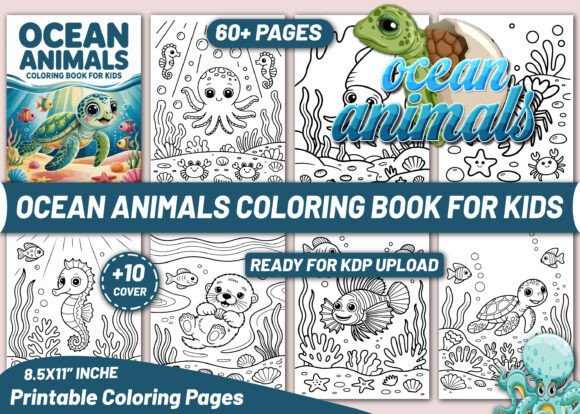
Imagine opening a digital toolkit that delivers not just coloring pages—but creative momentum. The Ocean Animals Coloring Book for Kids is precisely that: a professionally designed, production-ready collection built for creators who value quality, flexibility, and speed. With 60 high-resolution coloring pages (300 DPI), 10 editable premium book covers, and 100 unique animal illustrations—each optimized for print and digital use—it’s engineered to support real-world projects, not just passive consumption.
What Makes This Collection Stand Out?
It’s not just about quantity—it’s about intentionality in design and utility. Every illustration features clean, confident line work, balanced negative space, and age-appropriate detail levels—neither oversimplified nor overwhelming for children aged 3–10. The animals span diverse ocean zones: coral reef dwellers like clownfish and parrotfish, deep-sea oddities like anglerfish and viperfish, coastal residents like sea turtles and harbor seals, and even plankton-inspired patterns for early learners.
The file diversity matters too. Having each design in AI, PDF, JPG, PNG, and SVG means you’re never locked into one workflow. Designers can tweak layers in Illustrator, marketers can drop transparent PNGs into social ads, educators can extract SVGs for interactive whiteboard activities, and self-publishers can embed PDFs directly into KDP interiors—no conversion headaches, no quality loss.
Creative Applications Beyond the Obvious
This isn’t only for coloring books. Think of it as a modular visual library:
- Educational Resources: Pair pages with short marine biology facts (e.g., “Did you know octopuses have three hearts?”) to build science-themed activity packs for homeschoolers or after-school programs.
- Digital Learning Tools: Convert SVG files into animated coloring apps using lightweight web frameworks—add sound cues, gentle animations on stroke completion, or layered reveal effects for anatomy lessons (e.g., peel back a jellyfish’s bell to show its tentacles).
- Print-on-Demand Expansion: Use the cover templates to launch themed product lines—“Ocean Explorers Journal,” “Coral Reef Activity Planner,” or “Tide Pool Tracker”—all anchored by the same cohesive art style.
- Classroom Decor & Visual Aids: Enlarge select designs (like a life-size humpback whale outline) for wall displays, or shrink them into flashcards for vocabulary building (e.g., “mantle,” “gill slit,” “bioluminescence”).
How Different Users Can Adapt It Strategically
For KDP Publishers: The 8.5″ × 11″ no-bleed format aligns perfectly with Amazon’s standard interior requirements. Use the editable AI covers to test variations—swap fonts, adjust color palettes, or localize titles (“Océano Animales para Colorear” for Spanish-speaking markets)—without redesigning from scratch.
For Educators & Therapists: Print single pages for fine motor practice, or combine multiple species into sequencing cards (“Order the life cycle of a sea turtle”) or emotion-matching exercises (“Which ocean animal feels curious? Calm? Playful?”). The consistent line weight supports pencil control development across skill levels.
For Freelance Designers: License subsets of the collection to clients needing ocean-themed branding—think café menus with illustrated kelp borders, nonprofit campaign assets for marine conservation groups, or custom birthday invitations featuring personalized sea creature silhouettes.
For Bloggers & Content Creators: Embed high-res JPGs in tutorial posts (“How to Teach Ocean Zones Using Coloring Pages”), or use the SVGs as base layers for video overlays in YouTube explainers. The uniform style ensures visual cohesion across your content calendar.
Keeping Output Clear, Consistent, and Audience-Friendly
Clarity starts with selection—not every page suits every goal. When building a themed activity pack, group pages by complexity: start with bold, simplified outlines (starfish, seahorse) for younger kids; layer in mid-detail options (dolphins, stingrays) for ages 6–8; and reserve intricate scenes (a full coral reef ecosystem) for older children or collaborative classroom projects.
Consistency comes from intentional constraints. Stick to one primary font family across all covers and supplemental text. Limit accent colors to two or three when designing companion materials—navy, seafoam, and sand works universally and avoids visual fatigue. And always test printouts: what looks crisp on screen may blur slightly at 300 DPI if scaled incorrectly—preview at actual size before finalizing layouts.
Audience-friendliness means respecting context. A therapist using these for sensory regulation might avoid pages with dense clusters of tiny details; an ESL teacher might prioritize animals with strong phonetic associations (“squid,” “orca,” “urchin”) to reinforce pronunciation. Let purpose guide selection—not just aesthetics.
Realistic Inspiration You Can Implement Today
Try this: Pick three pages—one simple, one medium, one detailed—and turn them into a micro-workshop. For example:
- Scan or photograph a child’s completed coloring of the dolphin page.
- Overlay it digitally with a subtle SVG version of the original line art (using low opacity) to highlight how their interpretation adds personality.
- Turn that composite into a printable “My Ocean Art” certificate—adding their name, date, and a short reflection prompt (“What part was most fun to color?”).
That’s a 15-minute project with tangible emotional and developmental value—and it uses only assets already in the package.
Or, repurpose the SVG files into laser-cut stencils for tactile learning: cut out a manta ray shape from wood or acrylic, then let kids trace it onto paper or fabric while discussing migration patterns. The file versatility enables physical-digital bridges most collections don’t support.
This Ocean Animals Coloring Book for Kids doesn’t ask you to reinvent the wheel. It gives you precision-crafted wheels—and invites you to build something meaningful with them.