Puffy Baseball Alphabet: A Strategic Design Asset for Purpose-Driven Creatives
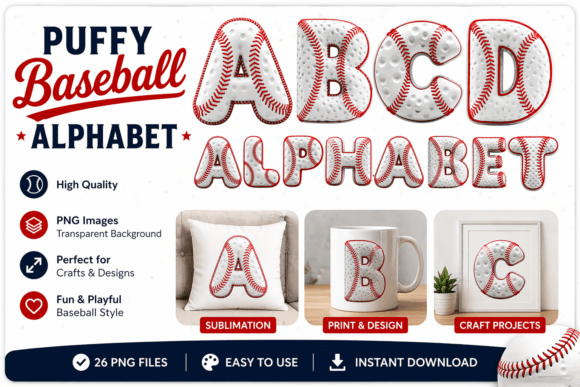
Design assets aren’t just decorative—they’re functional tools that shape perception, streamline execution, and reinforce intention. The Puffy Baseball Alphabet stands out not because it’s trendy, but because it bridges two often-competing priorities: thematic clarity and aesthetic versatility. It’s a curated set of 26 individual PNG files—each letter rendered with soft, dimensional volume, clean baseball-inspired stitching, and a smooth, tactile finish—all on transparent backgrounds. Unlike fonts or layered graphics, this is precision-crafted visual shorthand: sporty without cliché, playful without immaturity, elegant without detachment.
Why This Isn’t Just Another Alphabet Set
Most alphabet collections fall into one of two traps: they’re either overly literal (think oversized mitts forming letters) or so abstract they lose all thematic resonance. The Puffy Baseball Alphabet avoids both by anchoring its identity in texture and proportion—not iconography. The “puffiness” isn’t cartoonish exaggeration; it’s subtle dimensionality that implies softness, approachability, and craftsmanship. The stitching isn’t decorative filler—it’s a quiet nod to authenticity, to the hand-stitched seams of a well-loved glove. That combination makes it unusually adaptable across audiences and applications.
For a small business owner designing team apparel, that means consistency without rigidity: a monogrammed cap logo retains sophistication, while a youth league T-shirt stays age-appropriate. For a freelance designer building a client’s sports-themed rebrand, it offers immediate visual cohesion—no custom lettering needed, no stylistic compromises. And for an educator creating classroom materials about teamwork or local history, it delivers thematic relevance without infantilizing content.
Strategic Use Cases: Where Intention Meets Execution
Using the Puffy Baseball Alphabet effectively starts with aligning its qualities to your objective—not the other way around. Consider these grounded applications:
- Name designs and monograms: When personalization signals care (e.g., custom birthday banners or engraved gift tags), the soft volume of each letter adds warmth and distinction. Avoid scattering letters randomly—group them deliberately, respecting optical spacing and baseline alignment, even when working with PNGs.
- Baseball team graphics: Leverage the set for roster displays, award certificates, or season schedule posters. Its consistent style eliminates visual noise—critical when communicating across multiple touchpoints (digital rosters, printed programs, social media tiles).
- Kids’ apparel prints: Its rounded edges and gentle contrast make it legible at small scales and safe for screen printing or sublimation. But remember: fabric type, ink opacity, and garment color affect how puffiness reads—test print before bulk production.
- Birthday invitations and party kits: Here, the Puffy Baseball Alphabet serves dual roles—theme reinforcement and hierarchy support. Use larger letters for names (“JACK”), smaller ones for details (“June 15 • 2–4 PM”), maintaining consistent stroke weight and spacing to preserve cohesion.
- Sports-themed branding: Not just for teams—think community centers, youth camps, or athletic therapy studios. Its elegance allows integration alongside serif body text or minimalist icons, avoiding the “clipart overload” common in sector-specific design.
Planning Ahead: What to Confirm Before You Start
Because the Puffy Baseball Alphabet consists of individual PNG files—not a scalable font—you’ll need to plan for technical constraints upfront. Ask yourself:
- What’s my output medium? High-resolution PNGs work flawlessly for print (300 DPI), web (72–150 DPI), and embroidery digitizing—but only if you maintain original dimensions or scale proportionally. Upscaling beyond 200% risks visible pixelation.
- Do I need typographic flexibility? If your project requires dynamic text (e.g., auto-generated player names in a web app), this set won’t serve that need. It’s built for intentional, static composition—not automation.
- How will color function in context? Transparent backgrounds offer freedom, but they also shift perception based on underlying color. Test letters over your intended background(s)—a light gray letter may disappear on white, while a navy version might overwhelm pastel layouts.
- Is consistency non-negotiable? Since each letter is isolated, alignment, kerning, and vertical rhythm require manual adjustment. Use grid overlays in your design software. Don’t rely on visual estimation alone.
Risks of Using Without Context
Without clear goals, even strong assets can dilute impact. Deploying the Puffy Baseball Alphabet across every touchpoint—website headers, email footers, product labels—without strategic rationale leads to visual fatigue and weakens brand differentiation. Similarly, pairing it with clashing textures (e.g., grunge borders or neon gradients) undermines its core strength: refined sportiness. It’s also unsuited for formal legal documents, academic reports, or accessibility-first interfaces where high-contrast, sans-serif typography remains the standard for readability and compliance.
More subtly, overuse risks misalignment with audience expectations. A financial advisor launching a youth financial literacy program might find the Puffy Baseball Alphabet effective for workshop handouts—but inappropriate for investor-facing pitch decks. The key isn’t whether it “looks nice,” but whether it supports the message’s credibility, clarity, and emotional tone.
Long-Term Value: Beyond the First Project
Investment in design assets pays dividends when reuse is built into the workflow. The Puffy Baseball Alphabet supports long-term value in three practical ways:
- Speed-to-execution: Once you’ve established spacing rules, color palettes, and sizing conventions, future projects—from seasonal social posts to updated merchandise—take significantly less time. That’s measurable productivity gain, not just convenience.
- Brand continuity: When used selectively across campaigns (e.g., annual tournament branding or milestone celebrations), it becomes a recognizable motif—not a gimmick. Consistency over time builds subconscious recognition.
- Creative constraint as catalyst: Working within defined parameters—like fixed letter shapes and proportions—forces sharper decisions about layout, hierarchy, and supporting imagery. That discipline often yields more distinctive results than unlimited options.
A Final Note on Intentional Use
The Puffy Baseball Alphabet succeeds because it’s designed with restraint—not excess. Its power lies in what it doesn’t do: it doesn’t shout, doesn’t distract, doesn’t overpromise. It offers a quiet, confident visual language for creators who understand that the strongest communication often lives in the balance between theme and refinement. Whether you’re launching a new product line, supporting a community initiative, or elevating everyday client deliverables, let the asset serve your strategy—not the reverse. Choose where it appears, how it pairs, and why it matters in that specific moment. That’s how tools become assets, and assets become advantages.