Socks Mockup PSD
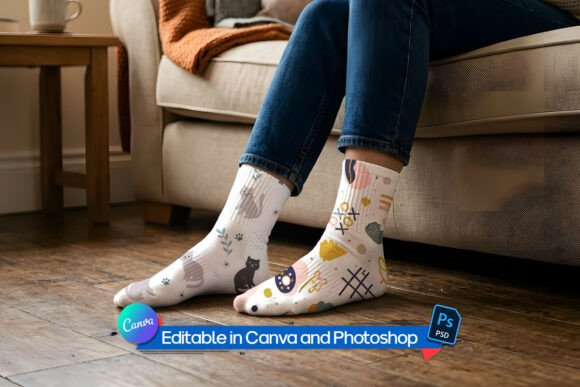
Presenting sock designs isn’t just about showing a pattern—it’s about conveying texture, fit, drape, and real-world wear. That’s where a well-crafted Socks Mockup PSD makes all the difference. Unlike flat templates or generic overlays, a true socks mockup replicates how fabric stretches over the foot, how light catches subtle seams and ribbing, and how shadows fall across natural folds. It bridges the gap between your digital artwork and how customers actually imagine wearing your design—whether it’s for an Etsy shop, a print-on-demand brand, or a textile portfolio.
Why “Realistic” Isn’t Just Marketing Talk
Many designers assume any layered PSD labeled “socks mockup” will do the job—only to discover later that the file lacks Smart Objects, uses low-res textures, or forces manual blending modes just to get basic opacity right. A genuine Socks Mockup PSD includes non-destructive layers with properly embedded Smart Objects, meaning you drop your pattern in once, resize or reposition without quality loss, and see immediate, photorealistic results. The fabric texture isn’t painted on—it’s mapped to follow the curvature of the sock. Shadows aren’t static—they shift subtly based on your design’s contrast and placement. That realism builds trust: shoppers are more likely to click “Add to Cart” when they can visualize how the print wraps around the heel or sits above the ankle.
Common Missteps—and What They Cost You
Mistake #1: Skipping the PDF guide before opening Photoshop. Some users dive straight into layering, only to miss that the mockup includes pre-labeled angle variations (front, side, angled top-down), alternate sock heights (ankle, crew, knee-high), or even left/right foot options. Without consulting the included Editable PSD PDF Guide, you might waste time duplicating layers manually—or worse, flatten critical adjustment layers by accident. One designer reported spending 45 minutes trying to replicate lighting effects, unaware the guide explained how to toggle built-in ambient occlusion layers in under 10 seconds.
Mistake #2: Assuming “high resolution” means “works at any size.” While the Socks Mockup PSD delivers professional-grade output, resizing beyond its native canvas dimensions (often 4000×3000 px) can blur fine knit details or soften shadow gradients. If you need billboard-sized visuals, export at native size first, then upscale using Photoshop’s Preserve Details 2.0—not bicubic interpolation. Better yet: check the mockup’s documentation for recommended use cases (e.g., “ideal for web thumbnails up to 2000 px wide” or “print-ready for 8×10” product cards).
Mistake #3: Overlooking file compatibility. This Socks Mockup PSD requires Photoshop CC 2019 or newer. Older versions may not support updated Smart Object nesting or layer effects like Color Lookup Tables used for realistic fabric tone shifts. If you’re on Photoshop Elements or Affinity Photo, this file won’t open as intended—even if the extension says “.psd.” Always verify software requirements *before* purchase. No workaround replaces native support when it comes to complex layer structures.
What to Check Before You Download or Buy
- Layer organization: Open a free sample (if offered) and look for clearly named folders—“Sock Body,” “Shadows & Highlights,” “Foot Base”—not just “Layer 1,” “Layer 2.” Well-structured files save hours during bulk uploads.
- Smart Object depth: Double-click a Smart Object thumbnail. Does it open a clean, isolated canvas with your design placeholder? Or does it reveal nested raster layers you’d need to edit individually? True efficiency lives in one-click updates.
- Texture fidelity: Zoom to 200%. Do knit lines appear consistent, or do they pixelate or repeat unnaturally? Realistic fabric detail depends on high-fidelity source photography—not tiled patterns.
- Licensing clarity: The Editable PSD PDF Guide should explicitly state commercial usage rights. Phrases like “for personal and commercial projects” are reassuring; vague language like “use as needed” invites risk.
Better Workflow Habits—Starting Today
Begin with your strongest design variant—not your draft. Since Smart Objects preserve editability, dropping in a final, color-corrected file avoids re-exporting multiple versions later. Name each placed Smart Object descriptively (“Stripe_Ankle_Sock_v2”) so you can batch-export dozens of mockups without confusion.
Use the mockup’s built-in shadow layers strategically. Instead of adding new drop shadows, adjust the opacity or blend mode of existing ones to match your background—especially useful for Instagram carousels where white vs. dark themes alternate. And remember: consistency matters. If you’re showcasing three sock styles, apply the same lighting angle and shadow intensity across all. Viewers subconsciously compare proportions and depth; mismatched lighting breaks immersion.
For educators or freelancers teaching surface pattern design, this Socks Mockup PSD doubles as a teaching tool. Show students how scale affects legibility on curved surfaces—zoom in on the arch area to demonstrate why tiny motifs vanish there, while bold repeats shine on the instep. That kind of applied insight sticks far longer than theory alone.
A Final Note on Value
A great Socks Mockup PSD isn’t about shortcuts—it’s about precision, respect for your audience’s perception, and honoring the craft behind your textile work. It saves time not by doing less, but by removing guesswork: no more staging photos with real socks, no more wrestling with perspective grids, no more client revisions because “it doesn’t look like it’ll fit right.” When your presentation feels intentional and tactile, your credibility rises—and so does conversion. That’s why checking the Editable PSD PDF Guide, testing layer behavior early, and aligning expectations with actual capabilities isn’t pedantic. It’s professional stewardship of your creative energy.