50 Animals Coloring Book Printable
If you’ve ever watched a child light up while coloring a lion or traced the outline of a flamingo with a student who’s just learned its name—you already know how powerfully art and language can work together. The 50 Animals Coloring Book Printable taps into that natural connection, turning vocabulary building into something tactile, joyful, and quietly effective.
What It Is—And Why It Feels Different
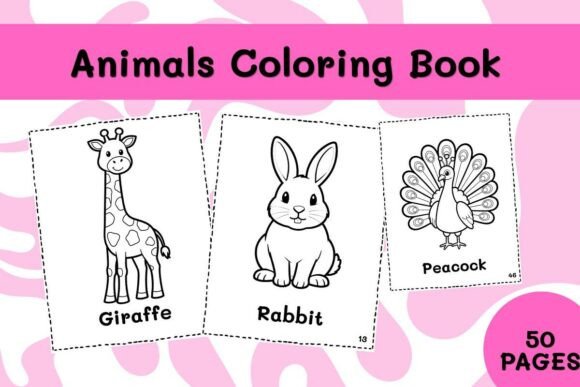
This isn’t just another collection of animal outlines. It’s a thoughtfully curated set of 50 ready-to-print coloring pages—each featuring a clearly illustrated animal paired with its name in bold, easy-to-read type. Designed at standard 8.5 x 11 inches, every page is optimized for home printers and classroom copiers. No cutting, no laminating, no prep: open the PDF, hit print, and hand it to a learner with crayons or colored pencils.
What makes it especially useful is how it bridges two foundational skills at once: visual word recognition and fine motor development. When a child says “octopus” while coloring each tentacle, they’re not just naming an animal—they’re reinforcing spelling patterns, syllable breaks, and letter-sound relationships—all without flashcards or worksheets.
Where This Resource Fits Into Real Life
Think about the last time you needed a low-lift, high-impact activity that worked across age ranges, learning styles, or language backgrounds. That’s where the 50 Animals Coloring Book Printable steps in—not as a standalone curriculum, but as a flexible, repeatable tool.
In the ESL or EFL Classroom
For teachers supporting English learners, animal vocabulary is often among the first thematic units—and for good reason. It’s concrete, universally recognizable, and rich with opportunities for extension (habitats, diets, movement verbs, plural forms). One teacher in Toronto uses these pages during “quiet literacy centers”: students color while listening to audio pronunciations, then cut out their animals to label a class mural. Another pairs them with simple sentence frames (“The ___ has ___”) for early writing practice.
In Homeschool Routines
Parents juggling multiple ages or limited planning time appreciate how easily this adapts. A 6-year-old colors the “kangaroo” page while practicing letter ‘K’ sounds; a 9-year-old adds facts on the back (“Kangaroos can’t walk backward!”); a teen learning Spanish uses the same image to write translations or compare anatomy terms. Because it’s no-prep, it fits seamlessly into rhythm-based days—no frantic searching for activities mid-morning.
In Therapy & Special Education Settings
Occupational therapists use animal coloring pages like these to support pencil control, bilateral coordination (holding paper steady while coloring), and visual attention. For learners with ADHD or autism, the predictable structure—clear line art, consistent layout, familiar subject matter—reduces cognitive load while still inviting creativity. Several SLPs report using the pages as visual supports during articulation practice, especially for challenging sounds like /r/ (rhinoceros), /th/ (moth), or /j/ (jaguar).
In After-School Programs & Summer Learning
When screen time needs balancing—or when energy runs high but focus is low—these pages offer calm engagement. A youth librarian in Austin rotates through themed weeks: “Ocean Animals,” “Nighttime Creatures,” “Farm Friends.” Kids keep their completed pages in a personal “Animal Atlas,” adding labels, fun facts, or even doodled habitats over time. It builds continuity without pressure.
Who Benefits—and How They Use It Differently
- Classroom teachers use it for early finishers, sub plans, or morning warm-ups—especially when aligning with science units on classification or ecosystems.
- Homeschooling caregivers layer it into unit studies: pair “bee” with pollination experiments, “wolf” with folklore discussions, or “penguin” with geography lessons on Antarctica.
- ESL tutors print single pages for targeted sound practice, matching games, or “find-and-color” listening tasks (“Color the animal that lives in trees”).
- Grandparents and caregivers find it ideal for intergenerational connection—coloring side-by-side while sharing stories about pets, zoos, or childhood farm visits.
Things to Keep in Mind Before You Start
While the 50 Animals Coloring Book Printable is intentionally simple, thoughtful use means noticing what works best for your context:
- It’s designed for clarity—not complexity. Line art is bold and uncluttered, ideal for younger learners or those developing visual processing skills—but may feel too basic for advanced artists seeking detailed illustrations.
- Vocabulary is intentionally accessible. Words like “frog,” “owl,” and “seal” appear alongside less common ones like “okapi” and “quokka.” That range supports differentiation, but educators working with very young beginners might want to pre-select pages based on phonics scope or sight-word lists.
- No digital interactivity is included. It’s a printable-only resource—so if you rely heavily on tablets or interactive whiteboards, consider scanning and importing pages into apps like Seesaw or Jamboard for annotation or voice recording extensions.
- It’s not labeled by difficulty level. You’ll need to preview pages to match them to your learners’ current vocabulary or motor skill level—but that also means full flexibility to curate your own sequence.
Why It Stands Out Among Vocabulary Tools
There are dozens of animal-themed flashcards, apps, and posters online—but few combine clean design, pedagogical intention, and zero-setup practicality the way this does. Its strength lies in what it doesn’t try to be: it won’t replace a structured phonics program, nor will it simulate a virtual zoo tour. Instead, it meets learners where they are—in the quiet space between hand and eye, sound and symbol—and lets meaning emerge through doing.
You’ll notice the difference when a hesitant reader points to “elephant,” says the word slowly, then smiles as they shade the trunk purple. Or when a shy ESL student confidently uses “butterfly” in a full sentence after three rounds of coloring and labeling. Those moments aren’t flashy—but they’re where real vocabulary takes root.
If you’ve used the 50 Animals Coloring Book Printable in a way that surprised you—or discovered a fresh twist on how it supports your goals—we’d love to hear about it. A quick 5-star review helps creators keep refining resources like this, and lets other educators, parents, and therapists find tools that truly fit their daily reality.