Control Your Emotions: Why Learning to React Less Is a Superpower in Modern Life
In a world of instant notifications, 24/7 news cycles, and constant social comparison, emotional reactivity has become the default—not the exception. You’ve felt it: that sharp spike of frustration when a text goes unanswered, the wave of defensiveness during feedback, or the guilt after snapping at a loved one. But what if you could pause—gently, intentionally—before reacting? Controlling your emotions isn’t about suppression or stoicism. It’s about cultivating awareness, building resilience, and choosing responses aligned with your values—not your impulses.
What Does “Control Your Emotions” Really Mean?
Let’s clear up a common misconception right away: Emotional control is not emotional denial. You won’t “delete” anger, sadness, or anxiety—and you shouldn’t try. These feelings are vital signals, evolved over millennia to protect, connect, and guide us. True emotional control means regulating your response—not erasing the experience. It’s the difference between feeling overwhelmed by stress and taking three conscious breaths before replying to a tense email.
Neuroscience supports this: The amygdala (our brain’s alarm system) reacts in under 1/10th of a second to perceived threats. But the prefrontal cortex—the seat of reasoning, empathy, and choice—takes slightly longer to engage. That tiny gap—often just seconds—is where emotional intelligence lives. Learning to react less isn’t passive; it’s an active, trainable skill rooted in self-awareness, attentional discipline, and compassionate curiosity.
At Work & in Leadership
Leaders who pause before responding foster psychological safety. A manager who hears disappointing quarterly results and says, “Let’s understand what happened—and how we adapt,” instead of blaming publicly, builds trust and innovation. Studies from Google’s Project Aristotle show that teams with high emotional regulation report 40% higher collaboration and problem-solving efficacy.
Within Relationships
Couples who practice “time-outs” during heated discussions—agreeing to pause for 20 minutes before continuing—report significantly higher relationship satisfaction. Why? Because space allows cortisol levels to drop, empathy to return, and language to shift from accusation (“You never listen!”) to vulnerability (“I felt unheard when…”).
In Personal Growth & Mental Wellness
Chronic reactivity fuels anxiety loops and drains mental energy. When you learn to observe emotions without immediate action—like watching clouds pass—you reduce rumination and build self-trust. Mindfulness-based cognitive therapy (MBCT), clinically proven to reduce relapse in depression, teaches precisely this: feeling ≠ acting.
How to Start—Practical, Science-Backed Strategies
You don’t need hours of meditation to begin. Small, consistent practices create lasting neural change:
- The 6-Second Pause: When triggered, silently count backward from 6 while breathing in for 4 counts and out for 6. This activates the vagus nerve, calming your nervous system.
- Name It to Tame It: Label your emotion aloud or in writing—“I’m feeling defensive,” “This is overwhelm.” Research shows naming reduces amygdala activation by up to 50%.
- Reframe the Narrative: Ask: “What’s the story I’m telling myself right now?” Often, assumptions (“They ignored me on purpose”) drive reactions—not facts.
- Create Response Rituals: Set boundaries like, “I’ll reply to emotionally charged emails after lunch,” or use a sticky note on your laptop: “Pause. Breathe. Choose.”
Design as a Daily Reminder: More Than Just a T-Shirt
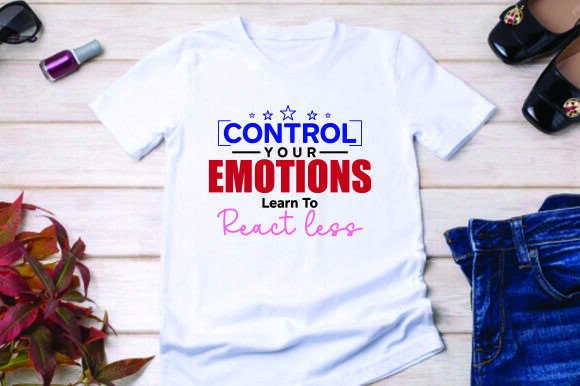
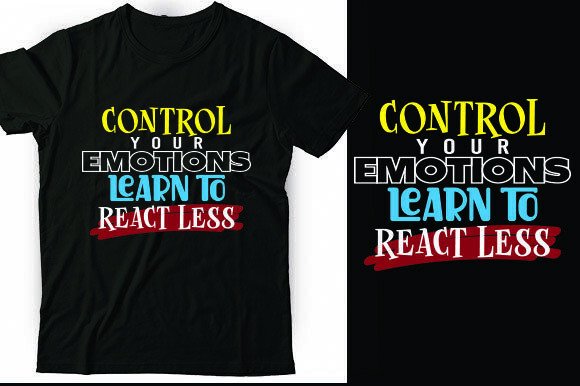
This is where thoughtful design meets intentional living. The “Control Your Emotions. Learn to React Less.” visual isn’t just witty typography—it’s a wearable anchor. Worn on a t-shirt, mug, or notebook, it serves as a gentle, public (and private) cue to return to presence. And because it’s delivered in multiple professional-grade formats—high-resolution JPG, editable AI file, scalable SVG, and transparent PNG (4500×5400 px at 300 dpi)—it’s built for real-world use: screen printing on organic cotton tees, vinyl cutting for laptop decals, or digital integration into mindfulness course materials.
Unlike generic motivational slogans, this phrase avoids toxic positivity. It doesn’t say “Be happy!” or “Just think positive!” Instead, it honors the complexity of human emotion while inviting agency. That nuance matters—especially for educators creating SEL (Social-Emotional Learning) resources, therapists designing client handouts, or entrepreneurs building wellness-branded merchandise that resonates authentically.
Common Pitfalls—and How to Avoid Them
As you practice, watch for these subtle traps:
- Mistaking numbness for mastery: If you feel disconnected, flat, or “fine” all the time, you may be suppressing—not regulating. Healthy regulation includes joy, grief, excitement, and tenderness—not just calm.
- Using control as control: Trying to manage others’ emotions (“Just relax!”) or weaponizing stillness (“I’m not angry—I’m disappointed”) undermines authenticity. Regulation begins with self—not others.
- Expecting linear progress: Some days will feel effortless; others, old triggers will flare. Progress isn’t perfection—it’s noticing the pattern sooner and returning more gently.
From Awareness to Action: Integrating This Into Your Routine
Start small—but start daily:
- Morning intention: Before checking your phone, ask: “How do I want to meet today’s challenges—with reactivity or responsiveness?”
- Micro-journaling: At day’s end, jot one moment you paused—and one where you wish you had. No judgment. Just data.
- Environment design: Place your “React Less” design where you’ll see it during high-stress transitions—on your bathroom mirror, laptop wallpaper, or coffee maker.
Remember: Emotional regulation is like physical fitness. You wouldn’t expect six-pack abs after one workout—and you won’t master composure after one mindful breath. But every pause, every named feeling, every chosen response strengthens your inner architecture.
Final Thought: Your Emotions Are Messengers—Not Masters
“Control Your Emotions. Learn to React Less.” isn’t a command—it’s an invitation. An invitation to reclaim your attention, deepen your relationships, lead with clarity, and live with greater alignment. In a culture that rewards speed over substance and reaction over reflection, choosing stillness isn’t weakness. It’s wisdom. It’s courage. It’s the quiet revolution happening one breath, one pause, one conscious choice at a time.
Whether you’re printing this design on sustainable apparel, using the SVG to craft a classroom poster, or saving the transparent PNG as your phone lock screen—let it remind you: You are not your reaction. You are the space in which it arises—and the choice you make next.