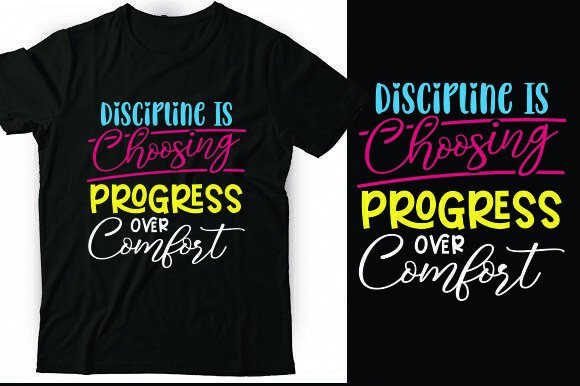
Discipline Is Choosing Progress Over Comfort
At its core, Discipline Is Choosing Progress Over Comfort is more than a phrase—it’s a behavioral compass. It names a quiet but consistent pivot: the deliberate decision to act in alignment with long-term growth, even when short-term ease pulls in the opposite direction. Unlike motivation, which fluctuates with mood or circumstance, this kind of discipline is rooted in intentionality. It shows up not when energy is high, but when resistance is present—when hitting snooze feels easier than rising for a workout, when scrolling distracts from drafting a proposal, or when silence feels safer than initiating a difficult conversation.
What Makes This Design Distinct—Beyond the Words
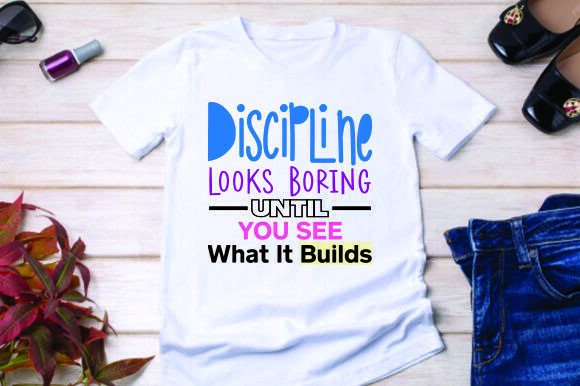
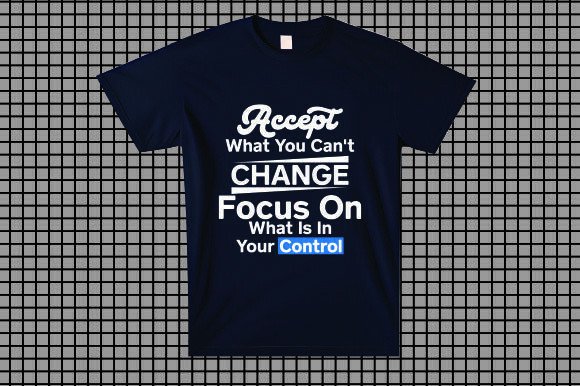
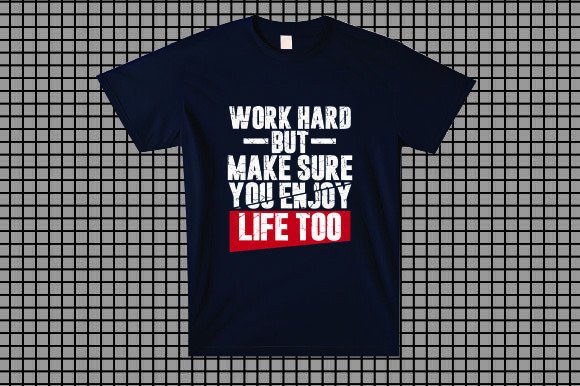
The Discipline Is Choosing Progress Over Comfort design isn’t just typography with meaning—it’s a visual distillation of mindset. The layout balances clarity and impact: clean lines, intentional spacing, and restrained contrast ensure readability across product types—from a curved ceramic mug to a textured canvas tote. Unlike many motivational designs that rely on dense script fonts or aggressive gradients, this version prioritizes legibility at multiple scales and backgrounds. Its 4500×5400 px, 300 dpi resolution supports sharp printing on apparel without pixelation, while the transparent PNG allows seamless layering over patterns or photos.
What sets it apart from generic “motivational quote” assets is its specificity. Phrases like “Hustle Harder” or “Dream Big” are broad; they invite interpretation but offer little behavioral scaffolding. In contrast, Discipline Is Choosing Progress Over Comfort names both sides of the internal trade-off—progress *and* comfort—and frames discipline as an active choice between them. That duality makes it especially resonant for adults navigating real-world constraints: parents balancing self-development with caregiving, freelancers managing inconsistent income while building skills, or professionals transitioning careers mid-decade.
How It Compares With Other Motivational Design Approaches
Motivational text-based designs fall along several practical dimensions: purpose, adaptability, audience resonance, and production readiness. Here’s how Discipline Is Choosing Progress Over Comfort fits within that landscape:
- Clarity vs. abstraction: Compared to abstract illustrations (e.g., mountain silhouettes, rising suns), this design communicates immediately—no decoding required. That makes it stronger for merchandise where message speed matters, like event swag or retail shelf appeal.
- Timelessness vs. trend-dependence: While some typography trends lean heavily into maximalist fonts or retro filters, this design avoids stylistic shortcuts that date quickly. Its minimal aesthetic holds up across seasons and platforms—unlike meme-style quotes or overly stylized brush scripts that can feel dated within months.
- Use-case flexibility: Many quote-based designs are optimized for one format (e.g., square social posts) and scale poorly to tall mugs or wide tote bags. This file package includes SVG (vector, infinitely scalable), AI (fully editable layers), JPG (print-ready raster), and transparent PNG—giving users control over placement, color adjustment, and background integration without quality loss.
- Emotional precision: Not all motivational language lands the same way. “You Got This” offers warmth but little direction. “No Pain, No Gain” implies struggle without naming agency. Discipline Is Choosing Progress Over Comfort, by contrast, acknowledges comfort as valid—even desirable—while positioning progress as a conscious alternative. That nuance aligns better with adult learners, therapists, coaches, and educators who prioritize self-awareness over pressure.
Strengths and Practical Tradeoffs
The strength of this design lies in its functional simplicity and psychological fidelity. Because it’s delivered as a ZIP folder containing four complementary file types, users avoid common friction points: no need to trace raster images, no guesswork about safe margins, no licensing ambiguity for commercial use (assuming standard personal/commercial terms apply). The editable AI file means designers can adjust weight, spacing, or color mode without starting from scratch—valuable when matching brand palettes or adapting for dark-mode apparel.
However, it’s not universally optimal. For audiences seeking emotional warmth or relational connection—think wellness communities focused on compassion or recovery groups emphasizing gentleness—this phrasing may feel too stark or individualistic. Similarly, if your goal is visual storytelling (e.g., illustrating growth through layered icons or metaphors), a text-only design won’t replace custom illustration work. And while the typography is clean, it doesn’t include alternate font variants or multilingual versions—so teams serving diverse linguistic audiences would need to adapt it manually.
When This Design Fits—and When It Doesn’t
This design serves best when the goal is clear communication of a specific mindset principle—not inspiration as decoration, but as orientation. It works well for:
- Coaches or trainers creating branded merch for clients working on consistency (e.g., habit-building programs, fitness challenges, writing sprints)
- Educators designing classroom posters or digital resources for middle school through adult learning settings
- Small businesses selling lifestyle products aligned with intentional living—think minimalist stationery brands, yoga studios, or productivity toolkits
- Designers building starter kits for beginners learning t-shirt layout fundamentals, given the included AI and SVG files
It’s less suited for contexts requiring emotional softness, cultural specificity, or narrative depth. A grief support group wouldn’t benefit from this framing; neither would a campaign centered on collective action (“We Rise Together”) or systemic change (“Justice Is Not Optional”). Likewise, if your audience responds better to questions than statements (“What’s one small step you’ll take today?”), or prefers imagery-driven metaphors (a seedling pushing through concrete), another approach may resonate more deeply.
Real-World Use Cases—Beyond the Obvious
While shirts and mugs are common applications, the versatility of the file package opens less obvious uses. A therapist might print the transparent PNG on matte cardstock, cut it into pocket-sized reminders for clients navigating anxiety-driven avoidance. A university writing center could embed the SVG into a digital handout about revision stamina—scaling it subtly into headers without overwhelming text. A remote team using Notion for project tracking might paste the JPG into sprint retrospectives as a gentle nudge toward iterative improvement over perfectionism.
Importantly, the design doesn’t assume uniform access to time, energy, or resources. Its power comes from naming the choice—not demanding it be made perfectly, daily, or under ideal conditions. That realism helps it avoid the burnout-adjacent messaging found in some “grind culture” assets. You don’t need to choose progress *every* time—just recognize when you’re choosing comfort, and whether that aligns with where you want to go.
Making an Informed Choice
If you’re evaluating Discipline Is Choosing Progress Over Comfort alongside other quote-based design resources, consider these decision factors:
- Intended audience: Do they value precision over positivity? Are they more likely to engage with ideas that name tension than those that promise ease?
- Production needs: Do you require vector scalability, transparency, or layered editing—or is a static JPG sufficient for your use case?
- Longevity: Will this be used once (e.g., a conference giveaway) or repeatedly (e.g., ongoing brand collateral)? Designs with neutral aesthetics and semantic clarity tend to age better.
- Integration effort: Can your team or tools handle AI or SVG files—or would a simpler format reduce friction?
There’s no universal “best” motivational design—only what fits your context, values, and practical constraints. Discipline Is Choosing Progress Over Comfort stands out not because it’s louder or trendier, but because it meets people where they are: aware of comfort’s pull, curious about growth, and ready for language that honors both.