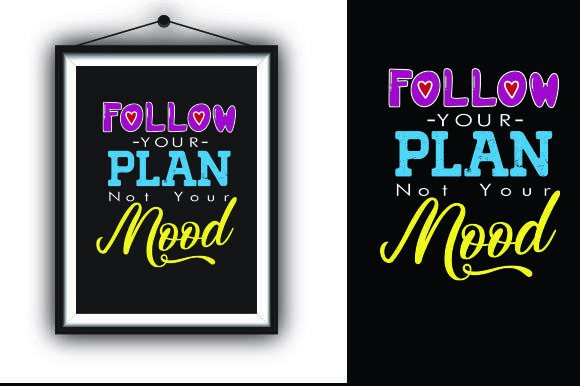
Follow Your Plan Not Your Mood
“Follow Your Plan Not Your Mood” isn’t just a catchy phrase—it’s a functional principle for people who build, launch, teach, create, sell, or lead. It reflects a deliberate shift from reactive decision-making to intentional execution. In practice, it means anchoring your actions in pre-defined structure—your plan—rather than letting fluctuating energy, emotion, or external noise dictate timing, scope, or quality. This mindset applies equally to launching a product line, delivering a workshop, editing a blog post, finalizing a client design, or even choosing which file formats to deliver with a digital asset.
Where the Principle Fits in Real Workflows
Most professionals don’t struggle with motivation—they struggle with consistency amid shifting conditions. A freelance designer may feel inspired on Monday but overwhelmed by Friday. An educator might plan a full week of lessons, only to have two students absent and a fire drill interrupt Tuesday’s flow. A small business owner could map out a Q3 marketing push, then pivot mid-month due to inventory delays. In each case, “Follow Your Plan Not Your Mood” serves as a quiet reset button—not rigid adherence, but disciplined recalibration.
The phrase works best when embedded early in a process: during planning, before launch, or at the start of a creative sprint. It’s not about ignoring mood entirely; it’s about recognizing that mood is data—not direction. Fatigue signals the need for rest, not abandonment of deadlines. Excitement signals momentum—not permission to skip quality checks. Clarity emerges when you treat your plan as the baseline, and your mood as context to be managed—not obeyed.
How This Design Supports Intentional Execution
The Follow Your Plan Not Your Mood design delivers more than visual appeal—it functions as both a reminder and a tool. Its clean, bold typography and balanced layout make it instantly legible on apparel, merchandise, and digital assets. But its real utility lies in how it integrates into your existing systems:
- Pre-project alignment: Print the transparent PNG on a notebook cover or laptop decal to reinforce daily intention before opening design software or scheduling tools.
- Client handoff: Include the editable AI file in your brand kit so clients can adapt colors or sizing without compromising fidelity—keeping your delivery consistent, regardless of their timeline or stress level.
- Team onboarding: Use the SVG version in internal slide decks or LMS modules to visually anchor team discussions around accountability, scope, and cadence.
- Product scaling: The high-res JPG (4500×5400 at 300 dpi) ensures crisp printing across shirts, mugs, tote bags, and vinyl decals—no reworking needed as your catalog grows.
All files are bundled in a single ZIP folder—no fragmented downloads, no missing layers. Extract once, and every format is ready for immediate use. That simplicity reduces friction between intention and action—a subtle but critical part of following your plan, not your mood.
Practical Integration Tips
Integration isn’t about adding another app or checklist. It’s about aligning the design—and the principle—with what you already do:
For Creators & Designers
Use the editable AI file as a template layer in your workflow. When building a new t-shirt series, drop this quote into your mockup grid alongside other motivational designs—but keep spacing, font hierarchy, and bleed margins locked to your brand guide. That way, consistency stays intact whether you’re designing at 8 a.m. or midnight.
For Educators & Coaches
Print the transparent PNG on sticker sheets and hand them out during goal-setting sessions. Ask participants to place one where they’ll see it daily—on a water bottle, planner, or laptop edge. The physical prompt reinforces behavior change more reliably than a digital notification ever could.
For Small Business Owners
Bundle the design with your digital product launches—not as an afterthought, but as part of your value stack. Pair it with a short email script: *“This isn’t just a quote—it’s our shared commitment to showing up, even when it’s hard.”* That frames consistency as collaboration, not pressure.
Compatibility, Organization, and Long-Term Use
This design was built for longevity—not trends. The neutral color palette, strong contrast, and scalable vector foundation ensure it remains usable across platforms and print methods for years. Unlike trend-dependent graphics that age quickly, “Follow Your Plan Not Your Mood” gains relevance over time—especially as teams grow, workflows mature, and goals evolve.
Organizationally, the file set supports multiple access points: - The JPG works for quick social posts or email banners. - The SVG scales cleanly for web use or Cricut projects. - The transparent PNG drops seamlessly into Canva, Figma, or PowerPoint without background cleanup. - The AI file preserves layers, fonts, and vector paths—so you can adjust text, recolor elements, or export alternate versions without starting over.
No conversion steps. No compatibility warnings. Just plug-and-play usability—because the fewer technical hurdles between plan and execution, the easier it is to follow through.
Workflow Observations Worth Noting
People often assume discipline requires suppression—of emotion, doubt, or fatigue. In reality, sustainable execution relies on structure that accommodates humanity. When you “Follow Your Plan Not Your Mood,” you’re not denying feeling—you’re choosing where to assign authority. Your plan holds the standards; your mood informs pacing, breaks, and communication style.
That distinction becomes especially clear during collaborative work. A team member might say, “I’m not feeling it today”—and that’s valid. What matters is whether the sprint board still reflects committed deadlines, whether the design review calendar remains scheduled, and whether the ZIP folder with finalized assets gets uploaded on time. The design doesn’t erase emotion—it creates space for it within boundaries that protect outcomes.
Also worth noting: this principle compounds. The more consistently you apply it—even in small ways—the more your brain learns to trust the plan itself. Over time, “Follow Your Plan Not Your Mood” stops sounding like discipline and starts feeling like rhythm.
Final Thought: It’s About Trust, Not Control
At its core, “Follow Your Plan Not Your Mood” is about trusting your past self—the one who mapped the path, weighed trade-offs, and set realistic parameters. It’s not control over circumstance; it’s stewardship of intention. Whether you’re using the editable AI file to customize a client presentation, printing the high-res JPG for a pop-up shop banner, or sharing the SVG in a team Slack channel—it all points back to one thing: honoring the clarity you built before the noise arrived.
That’s why this design belongs in your toolkit—not just as decoration, but as infrastructure. It’s not motivational wallpaper. It’s operational grounding.